Categories: Romance, Family, Contemporary, Young Adult, Coming of Age
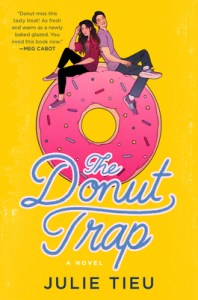
Julie Tieu sparkles in this debut romantic comedy, which is charmingly reminiscent of the TV show Kim’s Convenience and Frankly in Love by David Yoon, about a young woman who feels caught in the life her parents have made for her until she falls in love and finds a way out of the donut trap.
Jasmine Tran has landed herself behind bars—maple bars that is. With no boyfriend or job prospects, Jasmine returns home to work at her parents’ donut shop. Jasmine quickly loses herself in a cyclical routine of donuts, Netflix, and sleep. She wants to break free from her daily grind, but when a hike in rent threatens the survival of their shop, her parents rely on her more than ever.
Help comes in the form of an old college crush, Alex Lai. Not only is he successful and easy on the eyes, to her parents’ delight, he’s also Chinese. He’s everything she should wish for, until a disastrous dinner reveals Alex isn’t as perfect as she thinks. Worse, he doesn’t think she’s perfect either.
With both sets of parents against their relationship, a family legacy about to shut down, and the reappearance of an old high school flame, Jasmine must scheme to find a solution that satisfies her family’s expectations and can get her out of the donut trap once and for all.
Content Warning: Anxiety, Family Pressures, Drug Use
Many of the books by Asian authors that I’ve been picking up lately has featured a main character whose parents/family are immigrants to the USA. It’s very relatable. What I love about the books I’ve read is that I’m learning about different Asian cultures and in this story Jasmine Tran’s parents journey to the USA is fascinating. They fled Cambodia because of the Khmer Rouge, ended up in Vietnam and changing their name to fit in and then fled Vietnam as refugees and made it to California. But at their family root, they are Chinese. In that essence, Jasmine isn’t fluent in Khmer, Chinese Mandarin or Vietnamese, all the languages her parents can speak. She also knows about their history but never lived through the trauma and doesn’t know why she feels so punished for it. There is the ever present feeling of not living up to her parents expectations.
I like how we see Jasmine go from feeling stuck in her situation working at their family owned donut shop to finding some self-confidence and taking a step out on her own. She grows a lot and I like the moment when she tries and communications everything she feels to her parents. It’s not easy but at least by then they made an effort to try and understand her.
The romance between Alex and Jas is really cute and realistic. I could relate to being hounded by my mom about when I was going to get married when I was in my early twenties. I had to constantly point out how they forbade me from dating in high school (and yes I had the whole secret boyfriend that Jasmine had LOL)…I’m telling you this book was so relatable. I like how it progressed naturally and the drama between was slight, yet still realistic. I did wish there was more chemistry between them – it seemed a bit lackluster but still, sweet.
My issue with the story is about Jasmine’s past, which we get no hint about until she remembers and reflects about that moment in time. It comes near the end of the book and was such a surprise but then it made sense why Jasmine was so stuck and afraid to make a move in her life. But it would have been nice to get glimpses of her past throughout the beginning of the book, then I would have understand why she was so hesitant in making certain decisions in her life.
Why you should read it:
relatable immigrant family issues
Cambodian, Chinese, Vietnamese rep
sweet romance
Why you might not want to read it:
needs more chemistry between Alex and Jas
My Thoughts:
The strongest parts of this book was how we get to see Jasmine’s struggles with living up to her parents expectations. I found Jasmine totally relatable when it came to dealing with pressures from her family and not really knowing where she fits in, or how to please them. As for the romance, it was sweet but lacking chemistry – this was more a coming of age story than a romance but still overall an enjoyable read as we see Jasmine grow.
📚 ~ Yolanda
Quotes from the Book:
“My parents weren’t heartless, but the trauma they had endured hardened them in ways I didn’t fully understand.”
The Donut Trap by. Julie Tieu
“If the measure of success was that I was living a more comfortable, easier life than they had, then why was I simultaneously penalized for it?”
The Donut Trap by. Julie Tieu
“My parents had rarely told us that they love us verbally. It wasn’t like we didn’t know. They showed us love in many ways, but hearing the actual words was a new feeling I had to break into.”
Categories: Romance, Family, Contemporary, Young Adult, Coming of Age, Fake Dating
A reserved Bangladeshi teenager has twenty-eight days to make the biggest decision of her life after agreeing to fake date her school’s resident bad boy. How do you make one month last a lifetime?
Karina Ahmed has a plan. Keep her head down, get through high school without a fuss, and follow her parents’ rules—even if it means sacrificing her dreams. When her parents go abroad to Bangladesh for four weeks, Karina expects some peace and quiet. Instead, one simple lie unravels everything.
Karina is my girlfriend.
Tutoring the school’s resident bad boy was already crossing a line. Pretending to date him? Out of the question. But Ace Clyde does everything right—he brings her coffee in the mornings, impresses her friends without trying, and even promises to buy her a dozen books (a week) if she goes along with his fake-dating facade. Though Karina agrees, she can’t help but start counting down the days until her parents come back.
T-minus twenty-eight days until everything returns to normal—but what if Karina no longer wants it to?
Content Warning: Anxiety, Family Pressures
All immigrant families want is a better life for their children and Karina knows this with all her heart. Her parents want her to be a doctor but she wants to major in English after high school and she is trying her best to make them happy. Karina gets a breather when her parents go to Bangladesh for a month.
First off, this story is relatable to a lot of immigrant or first generation American children. Parents uproot their whole lives in their motherland country to give their children a better life somewhere else. My parents were very strict as well, so I related to Karina a lot in that aspect. I love that she had her dadu for support and telling her she’s a good kid and loved – that’s so important because it’s so easy for teens to fear disappointing their parents and think they are loved less because they don’t stand up to their standards. Being a perfect child is so hard and such an unreasonable expectation. I loved that this story was about a Bangladeshi and Muslim girl and we got to see her family dynamics. Also Karina has major anxiety because of these family pressures and it was good to see how she suffers and deals with it. **I can’t comment much on the Muslim representation, I see a lot of reviews on Goodreads marking this book a low rating because of it. **
Karina had her dadu for support and her girlfriends. They are a tightly knit group of three girls just surviving high school and everything that comes with it.
She also has support from her new fake boyfriend and guy she’s tutoring for English, Ace. He’s popular, white and rich. Ace being white though wouldn’t fly with her parents but the heart wants what it wants. For a romance story I thought it was teen appropriate and so emo. Cheesy emo at times but this is definitely the kind of book I would have eaten up as a teenager! The whole fake-dating aspect was the main focus of this book, it was cute but nothing serious.
My favorite parts of this story was when Karina and her dadu were together. When Karina finally tells her parents that she doesn’t want to study medicine her dadu’s support made me want to cry because grandparents are just so amazing that way. I love how dadu stood up for Karina and made her parents listen to her.
Why you should read it:
teens can totally relate about dealing with family pressures
Bangladeshi and Muslim representation, anxiety rep
it’s a very teen romance, has fake dating but that’s not the focus of the story
Why you might not want to read it:
might appeal more to teenagers
My Thoughts:
The beginning of the book reads like a teen romance with the whole fake-dating trope thrown in but the real story for me was Karina dealing with the pressures from her family and trying to please them and yet want a little happiness for herself too. I love her dadu and the unconditional love and support she gets from her, it makes me wish I had someone backing me up that hard when I was Karina’s age. My grandparents were amazing but pretty much stayed out of my family dramas – they had enough drama I suppose with their own grown children! This story is relatable and perfect for teens who can relate trying to deal with family pressure.
📚 ~ Yolanda
Quotes from the Book:
“I’m expected to be this perfect daughter that I don’t know how to be.”
Counting Down with You by. Tashie Bhuiyan
“I am not Atlas, born to carry the weight of the world I am Icarus, wanting and wanting and wanting at the risk of exploding when I fly too close to the sun…”
Counting Down with You by. Tashie Bhuiyan
“Nothing I ever do is enough.”
Counting Down with You by. Tashie Bhuiyan
““The older I am, the more I realize it’s not worth it to prioritize things that make you miserable…”
Categories: Young Adult, Romance, High School, Fake-Dating, Enemies to Lovers, Coming of Age
From the author of The Best Laid Plans comes another fresh voiced, hilarious rom-com perfect for fans of Tweet Cute and The Rest of the Story.
Penny Harris just ruined her life.
As one of the most popular girls in school, she’s used to being invited to every party, is dating the Jordan Parker, and can’t wait to rule senior year with her best friend, Olivia. But when Penny wakes up on Jordan’s lawn the morning after his first-day-of-summer bash, she knows something went terribly wrong the night before.
She kissed Kai Tanaka.
Kai, her long-time nemesis. Kai, Olivia’s boyfriend. Penny can’t figure out what could have inspired her to do it–she loves Jordan and she would never hurt Olivia–but one thing’s for sure: freshly dumped, and out a best friend, the idyllic summer she pictured is over.
And despite the fact that Jordan seems to be seeking comfort (and a whole lot more) in Olivia, all Penny can think about is winning him back. Kai wants to save his relationship too, so they come up with a plan: convince their friends that they really do have feelings for each other. After all, no one can resist a good love story, and maybe seeing Penny and Kai together will make Jordan and Olivia change their minds.
But as summer heats up, so does Penny and Kai’s “relationship,” and Penny starts to question whether she’s truly faking it with Kai, if he’s really as terrible as she always thought he was, and if the life she’s fighting so hard to get back is the one she really wants.
Content Warning: Bullying
Penny is that girl who wasn’t always popular but once she became best friends with Olivia, the queen bee at school, she’s been her number two girl and she tries her best to keep her spot. This makes Penny a follower, and not the most likable character but she is relatable because she used to be the one who was bullied. It makes sense she doesn’t want to be bullied anymore but being friends with Olivia makes her a bully too.
As far as the romance, it’s an enemies to lovers, fake-dating situation where her enemy is the one who came up with the name she was bullied with! It’s natural that Penny hates Kai, but as they get thrown together, they finally get to know one another and in essence both of them was trying to survive being picked on in school. The story has a lot of high school drama but in a way I could understand Penny’s fears. Who likes to be bullied? No one.
Penny does grow by the end of this and I’m glad about that because it was hard to watch her try to find her way back to Olivia’s side when clearly Olivia is not a nice person and a worse friend at that. I like that Kai teaches her to let go a little and not be afraid to be herself. But it’s high school and people can change.
I do like how this author writes complicated and not automatically likable characters. They are flawed, make messy decisions, they are kids in high school who think everything matters in that very moment when as adults reading we know something bigger is coming their way. Bills. LOL…just kidding, but not kidding. 😅
Why you should read it:
fake dating, enemies to lovers
you like high school drama
realistic characters, even though not exactly likable, relatable high school situations
Why you might not want to read it:
you are not into the mean girls high school drama
My Thoughts:
Penny isn’t perfect, she is friends with a mean girl, and then she becomes one of the mean girls to survive. Penny and Kai’s enemies to lovers fake-dating situation helps them really get to know each other and pushes Penny to take a good look at who her friends are, and who she is without Olivia. Navigating high school is not easy and trying to figure out who you are in high school won’t happen overnight. Most people find ourselves after high school. This was full of messy high school drama, and as an adult I enjoyed it because it’s relatable. This one would appeal definitely appeal to teen readers.
📚 ~ Yolanda
Quotes from the book:
“If you make a bad choice, you have to try to fix it. You have to put in the work to make things better.”
Heartbreakers and Fakers by. Cameron Lund
“The truth is high school is such a small blip on my timeline. Life is too short to waste the whole thing worrying.”
Heartbreakers and Fakers by. cameron Lund
“Who cares if people are staring? The fact is, they probably aren’t even looking my way at all.”
Categories: Contemporary , Fantasy, Young adult, Romance, Nature, Environmental, Coming of Age
For centuries, witches have maintained the climate, their power from the sun peaking in the season of their birth. But now their control is faltering as the atmosphere becomes more erratic. All hope lies with Clara, an Everwitch whose rare magic is tied to every season.
In Autumn, Clara wants nothing to do with her power. It’s wild and volatile, and the price of her magic―losing the ones she loves―is too high, despite the need to control the increasingly dangerous weather.
In Winter, the world is on the precipice of disaster. Fires burn, storms rage, and Clara accepts that she’s the only one who can make a difference.
In Spring, she falls for Sang, the witch training her. As her magic grows, so do her feelings, until she’s terrified Sang will be the next one she loses.
In Summer, Clara must choose between her power and her happiness, her duty and the people she loves… before she loses Sang, her magic, and thrusts the world into chaos.
I love witch stories and this one sounded very different. The witches in this story are helping with weather disasters and trying to combat climate change – present issues we are dealing with! I thought it was a very unique take on what witches powers could be useful for in our present day.
Clara is an Everwitch – her seasonal powers don’t wane, she is powerful in all seasons as oppose to other witches who are powerful only in their season. But she doesn’t want this gift. People she love have died around her, because she can’t control her gift so she is at a school for witches to learn to control her powers. But what’s holding Clara back is herself. She meets a boy who finally teaches her to calm her insecurities and fears and to control her magic. Her journey comes full circle and we do get to see Clara embrace herself.
Sang is amazing and I loved his Spring affinity and talent with plants. He was the balance Clara needed and I loved watching their relationship go from friendship to more. The romance is so sweet. Clara is bisexual and we also get to meet her ex, another witch, Paige. There is some hard feelings between them but there is closure at the end also.
Content Warnings: death, grief
Clara is deep into her self-loathing and it takes up much of the story and it got repetitive – this whole story is about her journey to break through her fears and insecurities…I just wanted something more to happen. It would have been cool to see more severe weather events that affect shaders (non-witches) and the witches helping out. But this story is about Clara’s journey and it just takes too much of the first part of the story. The second half is much better because we see Clara grow and learn to control her power finally.
With Clara’s doubts and insecurities she lashes out a lot at her instructions and superiors. Everyone was an enemy to her and it got a little tiresome.
Even though the beginning lagged for me, there were some really good moments in the books. One of my favorites were how she and Sang communicated after they were in the middle of a break from one another. I thought in the essence of the romance story, Sang and Clara’s relationship was beautiful.
Why you should read it:
unique contemporary fantasy witch story – the witches are helping to combat climate change and maintain the environment – they tackle natural disasters
sweet, emotional romance story
Clara’s journey ends on a happy note
Why you might not want to read it:
Clara’s attitude – she’s going through a lot of emotional turmoil but she comes off selfish and stubborn
some parts are repetitive, especially when it comes to training Clara
My thoughts:
I keep going back and forth on my rating of this one. I loved the ending and the romance Clara has with Sang. I totally love how this is a unique witch story because they help with climate change which is a very important issue right now. I understand Clara’s grief and reluctance to use her power because it’s killed people she loves but I also wanted to shake her to see that a gift like hers cannot be wasted. She is the chosen one who doesn’t want to be chosen but it got tiresome. Despite my issues with it, I look forward to reading the next book from this author.
Disclaimer: **I received this book free from NetGalley in exchange for an honest review. All thoughts and opinions are my own.**
Thank you to Wednesday Books for giving me a chance to read this eARC in exchange for an honest review!
Nothing will get in the way of Millie Price’s dream to become a Broadway star. Not her lovable but super-introverted dad, who after raising Millie alone, doesn’t want to watch her leave home to pursue her dream. Not her pesky and ongoing drama club rival, Oliver, who is the very definition of Simmering Romantic Tension. And not the “Millie Moods,” the feelings of intense emotion that threaten to overwhelm, always at maddeningly inconvenient times. Millie needs an ally. And when a left-open browser brings Millie to her dad’s embarrassingly moody LiveJournal from 2003, Millie knows just what to do. She’s going to find her mom.
There’s Steph, a still-aspiring stage actress and receptionist at a talent agency. There’s Farrah, ethereal dance teacher who clearly doesn’t have the two left feet Millie has. And Beth, the chipper and sweet stage enthusiast with an equally exuberant fifteen-year-old daughter (A possible sister?! This is getting out of hand). But how can you find a new part of your life and expect it to fit into your old one, without leaving any marks? And why is it that when you go looking for the past, it somehow keeps bringing you back to what you’ve had all along?
Emma Lord has lately become a must read author for me. I enjoy her young adult contemporary stories very much! This book cover totally grabbed me with the colors and when I saw it was an Emma Lord book, I had to request it.
This one is for the broadway lovers. I love broadway shows but Millie Price LOVES broadway because her dream is to be a Broadway star – and this girl is not taking no for an answer. Millie is bold, vivacious and just so full of energy – her character pops off the page. Millie takes an intern job but she has an ulterior motive – she’s trying to find her mom. Yes…this is definitely like the broadway show Mamma Mia!, except instead of finding a dad, she tries to find her mom and has three candidates in mind because yes….she read her dad’s journal. Ha! I thought it was fitting.
The romance between Millie and Oliver is really cute. Oliver can’t quite stand Millie and vice versa but they are thrown together for the internship. It takes some time but the relationship grows into a truce, a friendship and then something much more. By the end I was invested in their relationship.
Millie’s search for her mom is the main part of the story and I thought the reveal was great and emotional. Not in that there were tears and what not between them, but there are a lot of revelations and a lot that Millie learned about her dad, her aunt, her bio mom and herself.
It took me awhile to get into this one and I can’t pinpoint why. It might be that I wasn’t in a Broadway kind of mood? I love Mamma Mia! and broadway but for some reason I couldn’t connect to Millie at first. But I’m glad I kept reading – I’m just bummed that I was struggling to get into the story because in the end, I did enjoy the second half of the book!
Why you should read it:
you love theater and broadway
a cute romance
reverse gender Mamma Mia!
Why you might not want to read it:
you don’t care for broadway
slow first half of the book
My Thoughts:
This one is not my favorite Emma Lord book but if you can get past the slow first half, it finishes off strongly with emotion and romance.
Categories: Young Adult, Coming of Age, Romance, Contemporary
High school senior Keely Collins takes on firsts, lasts, and everything in between in this sweet, sex-positive rom-com for fans of Meg Cabot and Jenny Han.
It seemed like a good plan at first.
When the only other virgin in her group of friends loses it at Keely’s own eighteenth birthday party, she’s inspired to take things into her own hands. She wants to have that experience too (well, not exactly like that–but with someone she trusts and actually likes), so she’s going to need to find the guy, and fast. Problem is, she’s known all the boys in her small high school forever, and it’s kinda hard to be into a guy when you watched him eat crayons in kindergarten.
So she can’t believe her luck when she meets a ridiculously hot new guy named Dean. Not only does he look like he’s fallen out of a classic movie poster, but he drives a motorcycle, flirts with ease, and might actually be into her.
But Dean’s already in college, and Keely is convinced he’ll drop her if he finds out how inexperienced she is. That’s when she talks herself into a new plan: her lifelong best friend, Andrew, would never hurt or betray her, and he’s clearly been with enough girls that he can show her the ropes before she goes all the way with Dean. Of course, the plan only works if Andrew and Keely stay friends–just friends–so things are about to get complicated.
Cameron Lund’s delightful debut is a hilarious and heartfelt story of first loves, first friends, and first times–and how making them your own is all that really matters.
First times are so awkward and I think the author captures that perfectly in this story. Keely is a virgin, and she thinks she’s the only one left at school who hasn’t done it. But when she meets a college guy who she wants to lose her virginity to, she doesn’t know how to go about it and asks her best friend Andrew to help her out.
Keely has a pretty good high school life. She’s part of the “in” crowd and gets invited to all the parties. Andrew’s best friends even consider her one of the guys. Her group of girlfriends are varied, Hannah, she totally clicks with, and Danielle not so much. These kids party, hook up a lot (except Keely) and they are soon going to graduate and get out of there – they definitely have that last hurrah vibe going on.
Keely and Andrew’s relationship is super cute. They are best friends but when things get hot and heavy, they try and go back to being best friends but it’s hard because Keely is starting to have feelings. It doesn’t help that Andrew is liking a new girl every week!
I like how the story shows how different everyone’s first time experience is with sex. It’s also awkward, and hopefully not humiliating (like Danielle’s experience), but no one wants to seem inexperienced even though they are! Also the story delved into the double standards of what happens when a girl loses their virginity, versus a guy losing theirs – totally not fair that right away a girl can be called a slut and a guy a stud.
Content Warning: slut shaming, underage drinking, misogyny
I wished Andrew and his friends stood up for Danielle more when someone was writing stuff about her on school walls. Or when Ryder was mouthing off and saying stupid things. It doesn’t seem like the girls at that school did much to defend her either, which was interesting so both guys and girls were slut shaming her. A lot of the guys in this book got away with being players and boy behaviors, which was annoying but I guess that was the point – to show the double standards between guys and girls.
Why you should read it:
sex positive
best friends to lovers
high school dating dramas
Why you might not want to read it:
high school dating dramas
the boys are so annoying 🤦🏻♀️
slut shaming and virgin shaming
My Thoughts:
The guys in this book are getting it way too easy. I liked how the story showed the double standards that girls face when it comes to sex. I thought Keely and Andrew’s friends to lover arc was cute. I found Keely’s concerns about being a virgin something that girls can relate to and all the other girl’s thoughts about sex was something I heard over the years from friends growing up as well. So overall I enjoyed the story and all the high school drama going on.
Categories: Young Adult, Contemporary, LGBT, Romance, Friendship, Coming of Age
Seventeen is nothing like Codi Teller imagined.
She’s never crashed a party, never stayed out too late. She’s never even been kissed. And it’s not just because she’s gay. It’s because she and her two best friends, Maritza and JaKory, spend more time in her basement watching Netflix than engaging with the outside world.
So when Maritza and JaKory suggest crashing a party, Codi is highly skeptical. Those parties aren’t for kids like them. They’re for cool kids. Straight kids.
But then Codi stumbles upon one of those cool kids, Ricky, kissing another boy in the dark, and an unexpected friendship is formed. In return for never talking about that kiss, Ricky takes Codi under his wing and draws her into a wild summer filled with late nights, new experiences, and one really cute girl named Lydia.
The only problem? Codi never tells Maritza or JaKory about any of it.
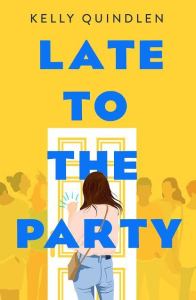
From author Kelly Quindlen comes a poignant and deeply relatable story about friendship, self-acceptance, what it means to be a Real Teenager. Late to the Party is an ode to late bloomers and wallflowers everywhere.
Late to the Party is about Codi who is tired of feeling “boxed in” her life and mostly by her friends. She’s had the same best friends, Maritza and JaKory for years and here they are, the summer before Senior year and they want to live a little. Her best friends want to be kissed, want to date someone or at least to know what it feels like to do any of those things. Codi wants it too but she doesn’t know how to go about changing her life until she runs into Ricky. He’s a year older, lives in her neighborhood and he doesn’t know if he is gay or not. Codi and Ricky bond together and it becomes a summer of changes – in ways unexpected.
Codi is a teenager, wanting a different kind of life, outside of what her best friends perceive her to be and I definitely went through that as a teenager. How do you know who you are if you are always with the same people? Especially if you don’t feel like who they think you are is not how you feel you are inside. So this story is about growing and Codi goes through a lot of it especially with her new friendship with Ricky.
Ricky is a great mirror for Codi, I adore him. He tells her things straight up and coming from a “stranger” who is a new friend and not her old friends, it’s a new voice telling her what she needs to hear. He shows her she can have fun and not be on the outside looking in all the time.
Codi and Lydia’s budding relationship is sweet and occurs naturally without too much drama which was nice to see. There is a lot of queer relationships in this book which was lovely. I also liked how Ricky wasn’t sure if he only liked guys or girls and guys – his confusion and anxiety and talking about everything with Codi was a breakthrough moment in their friendship.
Triggers: drinking alcohol
I didn’t quite connect to Codi, even though I could relate to her feelings of feeling trapped in a persona she wasn’t sure was truly herself. I just didn’t understand how she could ghost her best friends most of the summer and lie about hanging with Ricky and his friends. There were parts of her that seemed selfish but that was her point actually, she wanted something to be selfish about but it affected her relationship with her best friends and even her younger brother.
Why you should read it:
f/f and m/m relationships
nostalgia of those awkward teen years
very quick read
Why you might not want to read it:
nostalgia of those awkward teen years (lol)
My Thoughts:
This was a very quick read with a lot of queer representation and teens being teens – awkward, insecure, finding their way as they should be. Codi make mistakes and tries to fix said mistakes. Overall, it was an enjoyable story despite me not connecting to the main character as much as I would have liked.
Categories: Young Adult, Body Image, LGBTQIA+, Romance, Coming of Age, Small Town, Contemporary
Waylon Russell Brewer is a fat, openly gay boy stuck in the small West Texas town of Clover City. His plan is to bide his time until he can graduate, move to Austin with his twin sister, Clementine, and finally go Full Waylon, so that he can live his Julie-the-hills-are-alive-with-the-sound-of-music-Andrews truth.
So when Clementine deviates from their master plan right after Waylon gets dumped, he throws caution to the wind and creates an audition tape for his favorite TV drag show, Fiercest of Them All. What he doesn’t count on is the tape accidentally getting shared with the entire school. . . . As a result, Waylon is nominated for prom queen as a joke. Clem’s girlfriend, Hannah Perez, also receives a joke nomination for prom king.
Waylon and Hannah decide there’s only one thing to do: run—and leave high school with a bang. A very glittery bang. Along the way, Waylon discovers that there is a lot more to running for prom court than campaign posters and plastic crowns, especially when he has to spend so much time with the very cute and infuriating prom king nominee Tucker Watson.
Waylon will need to learn that the best plan for tomorrow is living for today . . . especially with the help of some fellow queens. . . .
I watched the movie Dumplin’ but never read the books and didn’t even know there was a book two! But I loved the cover of this one and decided to borrow it. I’m glad I did!
Waylon is fat, gay and has plans to leave the small town he’s from after graduation. Luckily he has a very supportive family and a lesbian twin sister, who is his best friend. He thought he knew his plans for life after high school but plans are changing and maybe for the better, though it doesn’t seem like it at first.
I loved a lot of things about this book. We meet Waylon, who is gay and out of the closet but still holding back a little and still exploring everything about his sexuality. He’s meeting guys, but still wants to meet the guy who won’t be ashamed to be with him in public. He is trying out drag, even though he doesn’t know how to put on makeup and enjoys being on stage. Waylon’s family is awesome. They are so super supportive from his grandparents down to his twin sister who is also part of the LGBT+ community. She has a girlfriend Hannah, who I believe was in Dumplin’.
We have a lot of representation and diversity in this story. There is an LGBT school club called Prism and mind you, this story is set in a small town in Texas. There is a m/m couple, and a f/f couple, which I adored because these couples were in loving relationships and we get to see that love. And of course there is a drag show – I feel like there should always be a drag show in this series!
Waylon doesn’t only deal with being gay but being fat as well. For the most part he is confident about himself until he is with his ex-friend Kyle who used to be fat and lost weight or if he’s an event where his body would be exposed, like the pool. But mostly Waylon doesn’t let it stop him from living. He is a good son, grandson and brother – he’s funny and charming.
I enjoyed the romance! For one, his sister, Clem and her girlfriend Hannah, are the whole opposites attract cuteness. Waylon has some prospects as well and the chemistry with Tucker is heart-thumping! I mean, Tucker was flirting-flirting! I totally understood Waylon’s insecurities about the whole thing though.
Triggers: bullying, body shaming, homophobia, alcoholism
Waylon has a supportive group of people in his family, but at school it’s a little bit different. He doesn’t do anything to stand out and say he’s gay – he tries to blend in, even though he is out of the closet. Many of the jocks bully him about being fat and gay – that’s why it was interesting to see Tucker’s reaction to it all, since he was a jock too or friends with them.
Kind of wished I read the two previous books because I don’t know if I missed anything? I felt like I did because there is a cast of characters I don’t remember such as, Millie and Callie. But even without reading the books, I enjoyed Pumpkin a lot.
Overall I thought this book was fun, heartfelt, well-written and a joy to read. I cared about Waylon and his lovely family and the sparks between him and Tucker were undeniable. It has a happy ending and this should definitely be made into a movie like Dumplin’.
📚~ Yolanda
Quotes From the Book:
Ground shifts around you and you figure out the fastest way to fall is to stand still. But sometimes when we know we need to take a leap, we’re jumping off the wrong cliffs.”
-Pumpkin by. Julie Murphy
You gotta get it wrong before you can get it right.”
-Pumpkin by. Julie Murphy
When the world isn’t selling what you’re looking to buy, you just have to take it upon yourself to cut your own pattern.”
Categories: WWII, Historical, Fiction, Holocaust, War, Romance
Disclaimer: **I received this book free from NetGalley in exchange for an honest review. All thoughts and opinions are my own.**
Thank you to Graydon House for giving me a chance to read this eARC in exchange for an honest review.
With the thrilling pace and historical drama of Pam Jenoff and Kristin Hannah, New York Times bestselling author Kelly Rimmer’s newest novel is an epic WWII saga and love story, based on the real-life efforts of two young people taking extraordinary risks to save their countrymen, as they try to find their way back to each other and the life they once knew.
Following on the success of The Things We Cannot Say, this is Kelly Rimmer’s return to the WWII category with a brand new novel inspired by Irena Sendler, the real-life Polish nurse who used her access to the Warsaw ghetto to smuggle Jewish children and babies to safety.
Spanning the tumultuous years between 1942 and 1945 in Poland, The Warsaw Orphan follows Emilia over the course of the war, her involvement with the Resistance, and her love for Sergiusz, a young man imprisoned in the Jewish ghetto who’s passion leads him to fight in the Warsaw Uprising. From the Warsaw ghetto to the Ravensbruck concentration camp, through Nazi occupation to the threat of a communist regime, Kelly Rimmer has penned her most meticulously researched and emotionally compelling novel to date.
Poland is ravaged on both sides in this war. The Soviet’s Red Army helps them liberate Poland from the Nazis but then the country comes under their rule. I definitely felt the anguish of the people of Poland and the exhaustion of never ending fighting for their country. We learn a lot about the Warsaw ghetto in Emilia’s (Elz-bieta) perspective being from outside the ghetto and Roman’s story from inside the ghetto.
Sara, the nurse who is helping smuggle children out of the ghetto is doing an amazing, stressful and life-threatening job. The story is loosely based on a real life nurse, Irena Sendler, who actually did smuggle children out of the Warsaw ghetto.
Through Roman, one of the main characters, we see his hunger to fight and keep fighting the Nazis and the Soviets. He is the anger in action. He joins the rebels who are fighting against the Nazis.
Emilia is an interesting character because she has a secret and she is very young in this venture of saving Jewish children in the ghetto. She’s only 14 and still so naive in some ways but she learns quickly. Emilia and Roman reminds us how kids grew up too fast in this time of war. By the end of this story one of them is tired of fighting and the tired wants to keep on. They do have a love story among the despair but even in the end I wasn’t sure if they would make it.
The ending is quite emotional, I felt for both Emilia, Roman and their friends who survived what the Nazis did to the whole of Europe.
Triggers: starvation, death, violence, mass executions, rape
This is a war story and it is graphic. There is a lot of visual accounts of the atrocities in the ghetto and concentration camp that is horrifying.
I learned a lot about the Warsaw ghetto from this book. This is an emotional and heartbreaking story. But there are strong characters in this sad story, and people fighting to do what they can to fight the Nazis and help the children that they could. It’s a story about an ugly time in history and a country being torn apart from the war and hope for a better day, one day with no fighting. If you enjoy historical fiction especially about World War II and the Holocaust, then you should read The Warsaw Orphan.
📚 ~ Yolanda
About the Author:
Kelly Rimmer is the worldwide, New York Times and USA Today bestselling author of Before I Let You Go, The Things We Cannot Say, and Truths I Never Told You. She lives in rural Australia with her husband, two children and fantastically naughty dogs, Sully and Basil. Her novels have been translated into more than twenty languages. Please visit her at https://www.kellyrimmer.com/
Facebook: @Kellymrimmer
Twitter: @KelRimmerWrites
Instagram: @kelrimmerwrites
Book Excerpt:
1
Roman
28 March, 1942
The human spirit is a miraculous thing. It is the strongest part of us—crushed under pressure, but rarely broken. Trapped within our weak and fallible bodies, but never contained. I pondered this as my brother and I walked to a street vendor on Zamenhofa Street in the Warsaw Ghetto, late in the afternoon on a blessedly warm spring day.
“There was one right there,” he said, pointing to a rare gap in the crowd on the sidewalk. I nodded but did not reply. Dawidek sometimes needed to talk me through his workday but he did not need me to comment, which was fortunate, because even after months of this ritual, I still had no idea what to say.
“Down that alleyway, there was one on the steps of a building. Not even on the sidewalk, just right there on the steps.”
I fumbled in my pocket, making sure I still had the sliver of soap my stepfather had given me. Soap was in desperate demand
in the ghetto, a place where overcrowding and lack of running water had created a perfect storm for illness. My stepfather ran a tiny dentistry practice in the front room of our apartment and needed the soap as much as anyone—maybe even more so. But as desperate as Samuel’s need for soap was, my mother’s need for food eclipsed it, and so there Dawidek and I were. It was generally considered a woman’s job to go to the market, but Mother needed to conserve every bit of strength she could, and the street vendor Samuel wanted me to speak to was blocks away from our home.
“…and Roman, one was behind a big dumpster,” he hesitated, then grimaced. “Except I think we missed that one yesterday.”
I didn’t ask how he’d come to that conclusion. I knew that the answer was liable to make my heart race and my vision darken, the way it did sometimes. Sometimes, it felt as if my anger was simmering just below the surface: at my nine-year-old brother and the rest of my family. Although, none of this was their fault. At Sala, my boss at the factory on Nowolipki Street, even though he was a good man and he’d gone out of his way to help me and my family more than once. At every damned German I laid eyes on. Always them. Especially them. A sharp, uncompromising anger tinged every interaction those days, and although that anger started and ended with the Germans who had changed our world, it cycled through everyone else I knew before it made its way back where it belonged.
“There was one here yesterday. In the middle of the road at the entrance to the market.”
Dawidek had already told me all about that one, but I let him talk anyway. I hoped this running commentary would spare him from the noxious interior that I was currently grappling with. I envied the ease with which he could talk about his day, even if hearing the details filled me with guilt. Guilt I could handle, I probably deserved it. It was the anger that scared me. I felt like my grip on control was caught between my sweaty hands and, at any given moment, all it would take was for someone to startle me, and I’d lose control.
The street stall came into view through the crowd. There was always a crush of people on the street until the last second before seven o’clock curfew. This was especially the case in summer, when the oppressive heat inside the ghetto apartments could bring people to faint, besides which, the overcrowding inside was no better than the overcrowding outside. I had no idea how many people were inside those ghetto walls—Samuel guessed a million, Mrs. Kuklin´ski in the bedroom beside ours said it was much more, Mother was quite confident that it was maybe only a hundred thousand. All I knew was that ours was not the only apartment in the ghetto designed for one family that was currently housing four—in fact, there were many living in even worse conditions. While the population was a hot topic of conversation on a regular basis, it didn’t actually matter all that much to me. I could see with my own eyes and smell with my own nose that however many people were trapped within the ghetto walls, it was far, far too many.
When the vendor’s table came into view, my heart sank: she was already packing up for the day and there was no produce left. I was disappointed but not surprised: there had been no chance of us finding food so late in the day, let alone food that someone would barter for a simple slip of soap. Dawidek and I had passed a store that was selling eggs, but they’d want zloty for the eggs, not a tiny scrap of soap.
“Wait here a minute,” I murmured to my brother, who shrugged as he sank to sit on an apartment stoop. I might have let him follow me, but even after the depths our family had sunk to over the years of occupation, I still hated for him to see me beg. I glanced at him, recording his location to memory, and then pushed through the last few feet of people mingling on the sidewalk until I reached the street vendor. She shook her head before I’d spoken a word.
“I am sorry young man; I have nothing to offer you.”
“I am Samuel Gorka’s son,” I told her. It was an oversimplification of a complicated truth, but it was the best way I could help her place me. “He fixed your tooth for you, remember? A few months ago? His practice is on Miła Street.”
Recognition dawned in her gaze, but she still regarded me warily.
“I remember Samuel and I’m grateful to him, but that doesn’t change anything. I have no food left today.”
“My brother and I…we work during the day. And Samuel too. You know how busy he is, helping people like yourself. But the thing is, we have a sick family member who hasn’t—”
“Kid, I respect your father. He’s a good man, and a good dentist. I wish I could help, but I have nothing to give you.” She waved to the table, to the empty wooden box she had packed up behind her, and then opened her palms towards me as if to prove the truth of her words.
“There is nowhere else for me to go. I can’t take no for an answer. I’m going to bed hungry tonight, but I can’t let…” I trailed off, the hopelessness hitting me right in the chest. I knew I would be going home without food for my mother that night, and the implications made me want to curl up in a ball, right there in the gutter. But hopelessness was dangerous, at least in part because it was always followed by an evil cousin. Hopelessness was a passive emotion, but its natural successor drove action, and that action rarely resulted in anything positive. I clenched my fists, and my fingers curled around the soap. I pulled it from my pocket and extended it towards the vendor. She looked from my palm to my face, then sighed impatiently and leaned close to me to hiss,
“I told you. I have nothing left to trade today. If you want food, you need to come earlier in the day.”
“That’s impossible for us. Don’t you understand?”
To get to the market early in the day one of us would have to miss work. Samuel couldn’t miss work; he could barely keep up as it was—he performed extractions from sunup to curfew most days. Rarely was this work paid now that money was in such short supply among ordinary families like his patients, but the work was important—not just because it afforded some small measure of comfort for a people group who were, in every other way, suffering immensely. But every now and again Samuel did a favor for one of the Jewish police officers or even a passing German soldier. He had a theory that one day soon, those favors were going to come in handy. I was less optimistic, but I understood that he couldn’t just close his practice. The moment Samuel stopped working would be the moment he had to perform an honest reckoning with our situation, and if he did that, he would come closer to the despair I felt every waking moment of every day.
“Do you have anything else? Or is it just the soap?” the woman asked me suddenly.
“That’s all.”
“Tomorrow. Come back this time tomorrow. I’ll keep something for you, but for that much soap?” She shook her head then pursed her lips. “It’s not going to be much. See if you can find something else to barter.”
“There is nothing else,” I said, my throat tight. But the woman’s gaze was at least sympathetic, and so I nodded at her. “I’ll do my best. I’ll see you tomorrow.”
As I turned away, I wondered if it was worth calling into that store to ask about the eggs, even though I knew that the soap wasn’t nearly enough for a whole egg. It wasn’t enough for even half an egg here on the market, and the stores were always more expensive than the street vendors. Maybe they would give me a shell? We could grind it up and Mother could drink it in a little water. We’d done that once before for her. It wasn’t as good as real food, but it might help a little overnight. It surely couldn’t hurt.
As I spun back towards our apartment, a burst of adrenaline nearly knocked me sideways. Dawidek hadn’t moved, but two Jewish police officers were now standing in front of him. Like me, my brother was tall for his age—an inheritance from our maternal grandfather that made us look bizarre when we stood with Samuel and Mother, who were both more diminutive. Even so, he looked far too small to be crowded into the doorway of an apartment by two Jewish Police officers. That situation could turn to bloodshed in a heartbeat. The Kapo operated on a spectrum from well-meaning and kindly to murderously violent, and I had no way of knowing what kind of Kapo were currently accosting Dawidek. My heart thundered against the wall of my chest as I pushed my way back to them, knowing even as I approached that intervening could well get me shot.
For everything I had been through and for everything I had seen, the only thing that kept me going was my family, especially Dawidek. He was my favorite person in the world, a burst of purity in an environment of pure evil. Some days, the only time I felt still inside was when he and I were playing or talking in the evenings—and that stillness was the only rest I got. I could not live without him, in fact—I had already decided that if it came to that, I wouldn’t even try.
“Dawidek?” I called as I neared. Both Kapo turned toward me. The one on the left, the taller one, sized me up as if an emaciated, unarmed 16-year-old was any kind of threat. I knew from bitter experience that the smart thing to do would have been to let Dawidek try to talk his own way out of this. He was nine years old but used to defending himself in the bizarrely toxic environment of the Ghetto. All day long, he was at his job alone, and I was at mine. He needed his wits about him to survive even an hour of that, and I needed to trust that he could handle himself.
But I couldn’t convince myself to be smart, even when I knew that what I was about to do was likely to earn me, at best, a severe beating. I couldn’t even stop myself when the Kapo gave me a second chance to walk away. They ignored me and kept their attention on my brother. “Hey!” I shouted, loud enough that my voice echoed up and down the street, and dozens of people turned to stare. “He’s just a kid. He hasn’t done anything wrong!”
I was mentally planning my next move. I’d make a scene, maybe push one of the Kapo, and when they turned to beat me, Dawidek could run. Pain was never pleasant, but physical pain could also be an effective distraction from mental anguish, which was the worst kind. Maybe I could even land a punch, and that might feel good. But my brother stepped forward, held his hands up to me and said fiercely, “These are my supervisors, Roman. Just supervisors on the crew. We were just talking.”
My stomach dropped. My heartbeat pounded in my ears and my hands were hot.—I knew my face was flushed raspberry, both with embarrassment and from the adrenaline. After a terse pause that seemed to stretch forever, the Kapo exchanged an amused glance, one patted Dawidek on the back, and they continued down the street, both laughing at me. Dawidek shook his head in frustration.
“Why did you do that? What would you do, even if I was in trouble?”
“I’m sorry,” I admitted, scraping my hand through my hair. “I lost my head.”
“You’re always losing your head,” Dawidek muttered, falling into step beside me, as we began to follow the Kapo back towards our own apartment. “You need to listen to Father. Keep your head down, work hard and hope for the best. You are too smart to keep making such dumb decisions.”
Hearing my little brother echoing his father’s wisdom in the same tone and with the same impatience was always jarring, but in this case, I was dizzy with relief, and so I messed up his hair, and let out a weak laugh.
“For a nine-year-old, you are awfully wise.”
“Wise enough to know that you didn’t get any food for mother.”
“We were too late,” I said, and then I swallowed the lump in my throat. “But she said that we should come back tomorrow. She will set something aside for us.”
“Let’s walk the long way home. The trashcans on Smocza Street are sometimes good.”
We were far from the only family in the ghetto who had run out of resources. We were all starving and any morsel of food was quickly found, even if it was from a trashcan. Still, I was not at all keen to return to our crowded apartment, to face the disappointment in my stepfather’s gaze or to see the starvation in my mother’s. I let Dawidek lead the way, and we walked in silence, broken by his periodic bursts of commentary.
“We picked one up here… Another over there… Mordechai helped me with one there.”
As we turned down a quiet street, I realized that Dawidek’s Kapo supervisors were right in front of us, walking a few dozen feet ahead.
“We should turn around, I don’t want any trouble with those guys,” I muttered. Dawidek shook his head.
“They like me. I work hard and don’t give them any trouble. Now that you have stopped trying to get yourself killed, they won’t bother us, even if they do notice us.”
Just then, the shorter policeman glanced towards the sidewalk on his right, and then he paused. He waved his companion ahead, then withdrew something from his pocket as he crouched low to the ground. —I was far too far away to hear the words he spoke, but I saw the sadness in his gaze. The Kapo then rose and jogged ahead to catch up with his partner. Dawidek and I continued along the street, but only when we drew near where he had stopped did I realize why.
We had been in the ghetto for almost two years. Conditions were bad to begin with, and every new day seemed to bring new trials. I learned to wear blinders—to block out the public pain and suffering of my fellow prisoners. I had walked every block of the ghetto, both the Little Ghetto with its nicer apartments where the elite and artists appeared to live in relative comport, and through the Big Ghetto, where poor families like my own were crammed in, trying to survive at a much higher density. The footbridge on Chłodna Street connected the two and elevated the Ghetto residents above the “Aryan” Poles, and even the Germans, who passed beneath it. The irony of this never failed to amuse me when I crossed. Sometimes, I crossed it just to cheer myself up.
I knew the Ghetto inside and out, and I noticed every detail, even if I had taught myself to ignore what I saw as much as I could. I learned not to react when an elderly man or woman caught my hand as I passed, clawing in the hopes that I could spare them a morsel of food. I learned not to so much as startle if someone was shot in front of my eyes. And most of all, I learned to never look at the face of any unfortunate soul who was prone on the sidewalk. The only way to survive was to remain alert so I had to see it all, but I also had to learn to look right through it. The only way to manage my own broiling fury was to bury it.
But the policeman had drawn my attention to a scene of utter carnage outside of what used to be a clothing store. The store had long ago run out of stock and had been re-purposed as accommodation for several families. The wide front window was now taped over with Hessian sacks for privacy; outside of that window, on the paved sidewalk, a child was lying on her stomach. Alive, but barely.
The Ghetto was teeming with street children. The orphanages were full to bursting which meant that those who weren’t under the care of relatives or kindly strangers were left to their own devices. I saw abandoned children, but I didn’t see them.
I’d have passed right by this child on any other day. I couldn’t even manage to keep my own family safe and well, so it was better to keep walking and spare myself the pain of powerlessness. But I was curious about what the policeman had given the child, and so even as we approached her, I was scanning—looking to see what had caught his attention and to try to figure out what he’d put down on the ground.
Starvation confused the normal growth and development of children, but even so, I guessed she was two or three. She wore the same vacant expression I saw in most children by that stage. Patches of her hair had fallen out, and her naked stomach and legs were swollen. Someone had taken her clothing except for a tattered pair of underwear, and I understood why.
This child would not be alive by morning. Once they became too weak to beg for help, it didn’t take long, and this child was long past that point. Her dull brown eyes were liquid pools of defeat and agony.
My eyes drifted to her hands. One was lying open and empty on the sidewalk beside her, her palm facing upward, as if opening her hands to God. The other was also open, slumped against the sidewalk on the other side of her, but this palm was not empty. Bread. The policeman had pressed a chunk of bread beneath the child’s hand. I stared at the food and even though it was never going to find its way to my lips, my mouth began to water. I was torturing myself, but it was much easier to look at the bread than at the girl’s dull eyes.
Dawidek stood silently beside me. I thought of my mother, and then crouched beside the little girl.
“Hello,” I said, stiff and awkward. The child did not react. I cast my gaze all over her face, taking it in. The sharp cheekbones. The way her eyes seemed too big for her face. The matted hair. Someone had once brushed this little girl’s hair, and probably pulled it into pretty braids. Someone had once bathed this child, and tucked her into bed at night, bending down to whisper in her ear that she was loved and special and wanted.
Now, her lips were dry and cracked, and blood dried into a dirty black scab in the corner of her mouth. My eyes burned, and it took me a moment to realize that I was struggling to hold back tears.
“You should eat the bread,” I urged softly. Her eyes moved, and then she blinked, but then her eyelids fluttered and fell closed. She drew in a breath, but her whole chest rattled, the sound I knew people made just before they died—when they were far too ill to even cough. A tear rolled down my cheek. I closed my eyes, but now, instead of blackness, I saw the little girl’s face.
This was why I learned to wear blinders, because if you got too close to the suffering, it would burn itself into your soul. This little girl was now a part of me, and her pain was part of mine.
Even so, I knew that she could not eat the bread. The policeman’s gesture had been well-meaning, but it had come far too late. If I didn’t take the bread, the next person who passed would. If my time in the ghetto had taught me anything, it was that life might deliver blessings, but each one would have a sting in its tail. God might deliver us fortune, but never without a cost. I would take the bread, and the child would die overnight. But that wouldn’t be the end of the tragedy. In some ways, it was only the beginning.
I wiped my cheeks roughly with the back of my hand, and then before I could allow my conscience to stop me, I reached down and plucked the bread from under the child’s hand, to swiftly hide it my pocket. Then I stood, and forced myself to not look at her again. Dawidek and I began to walk.
“The little ones should be easier. I don’t have to ask the big kids for help lifting them, and they don’t weigh anything at all. They should be easier, shouldn’t they?” Dawidek said, almost philosophically. He sighed heavily, and then added in a voice thick with confusion and pain. “I’ll be able to lift her by myself tomorrow morning, but that won’t make it easier.”
Fortune gave me a job with one of the few factories in the ghetto that was owned by a kindly Jew, rather than some German businessman only wanting to take advantage of slave labor. But this meant that when the Kapo came looking for me at home, to help collect the bodies from the streets before sunrise each day, the only other viable person in our household was my brother.
When Dawidek was first recruited to this hideous role, I wanted to quit my job so that I could relieve him of it. But corpse-collection was unpaid work and my factory job paid me in food—every single day, I sat down to a hot lunch, which meant other members of my family could share my portion of rations. This girl would die overnight, and by dawn, my little brother would have lifted her into the back of a wagon. He and a team of children and teenagers, under the supervision of the Kapo, would drag the wagon to the cemetery, where they would tip the corpses into a pit with dozens of others.
Rage, black and red and violent in its intensity, clouded the edges of my vision and I felt the thunder of the injustice in my blood. But then Dawidek drew a deep breath, and he leaned forward to catch my gaze. He gave me a smile, a brave smile, one that tilted the axis of my world until I felt it chase the rage away.
I had to maintain control. I couldn’t allow my fury to destroy me, because my family was relying on me. Dawidek was relying on me.
“Mother is going to be so excited to have bread,” he said, his big brown eyes lighting up at the thought of pleasing her. “And that means Eleonora will get better milk tomorrow, won’t she?”
“Yes,” I said, my tone as empty as the words themselves. “This bread is a real blessing.”
My Rating: 2/5 Stars (DNF’ed @ 20% but read the ending)
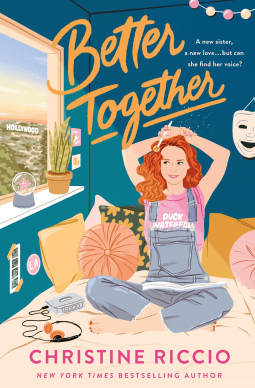
Title: Better Together
Author: Christine Riccio
Format: eBook (NetGalley)
Pages: 448
Publication Date: 6/1/21
Publisher: Wednesday Books
Categories: Contemporary, Young Adult, Sisterhood, Family, Romance
Disclaimer: **I received this book free from NetGalley in exchange for an honest review. All thoughts and opinions are my own.**
Thank you to Wednesday Books for giving me a chance to read this arc in exchange for an honest review!
Jamie’s an aspiring standup comic in Los Angeles with a growing case of stage anxiety.
Siri’s a stunning ballerina from New Jersey nursing a career-changing injury.
They’ve both signed up for the same session at an off the grid Re-Discover Yourself Retreat in Colorado. When they run into each other, their worlds turn upside down.
Jamie and Siri are sisters, torn apart at a young age by their parent’s volatile divorce. They’ve grown up living completely separate lives: Jamie with their Dad and Siri with their Mom. Now, reunited after over a decade apart, they hatch a plot to switch places. It’s time they get to know and confront each of their estranged parents.
With an accidental assist from some fortuitous magic, Jamie arrives in New Jersey, looking to all the world like Siri, and Siri steps off her flight sporting a Jamie glamour.
The sisters unexpectedly find themselves stuck living in each other’s shoes. Soon Siri’s crushing on Jamie’s best friend Dawn. Jamie’s falling for the handsome New Yorker she keeps running into, Zarar. Alongside a parade of hijinks and budding romance, both girls work to navigate their broken family life and the stresses of impending adulthood.
I liked the moment the sisters meet because we get to learn a bit of the back story of their history. It’s a sad history though and they get at least someone to help them navigate reintroducing one another to their lives again.
They are different in personality. Jamie is loud, says what she wants – she’s a comedian in life and as her profession. Siri is more subdued, was a ballerina until that dream came to a halt, so they are very different.
There is a happy ending (yes I read the ending), so it all works out with the family and the romance storylines in each girl’s life.
I couldn’t connect with any of the girls. I couldn’t get over Siri’s name being Siri, it just reminded me too much of Siri from the iPhone. Also, the fact that they were named after Game of Thrones characters (I Love GoT too but…), bugged me because Jamie and Cersei, the incestuous siblings? Interesting choice of names.
Jamie tries too hard and there is a lot of swearing (I don’t mind swearing) but a lot of it is in caps, so okay, Jamie is loud. But then her sister Siri likes to swear also…but using non-curse words such as “excrement” and just other random alternative curse words. But excrement is used a lot and after awhile it isn’t cute or funny.
I skipped a lot and apparently I skipped too much because there was a parent trap situation somewhere in the story and there’s magic that made that happen.
This one was clearly not for me since I did not finish and mostly skipped but I think there are readers out there who will enjoy it especially if you like stories like the Parent Trap.






































 Past Midnight Book Reviews & More